Category Archives: Tips

ANSI Paper Sizes

ANSI Paper Sizes adopted ANSI/ASME Y14.1. It is an American National Standards Institute that applies widely which defined a regular series of paper sizes based standard “letter size” which it assigned ANSI A. It is somewhat similar to the “ISO 216” standard.

The ANSI Series Sizes Standard serially as follow ANSI A, ANSI B, ANSI C, ANSI D, ANSI E, ANSI F, ANSI G, ANSI H, ANSI J, ANSI K. It is intended for “technical drawings”, hence sometimes labeled “Engineering”. This series is somewhat similar to the ISO standard in that cutting a paper in half would produce two papers of the next smaller size and therefore also includes “Ledger” or “Tabloid” as ANSI B.

  1. The ANSI Series Paper Sizes in mm, cm, inch
    1. ANSI A
    2. ANSI B
    3. ANSI C
    4. ANSI D
    5. ANSI E
    6. ANSI F
    7. ANSI G
    8. ANSI H
    9. ANSI J
    10. ANSI K
  2. Table

The ANSI Series Paper Sizes in mm, cm, inch

ANSI A Paper Size

The dimension of ANSI A Paper Sizes in mm, cm, inch:

  • ANSI A Size in mm is 216 × 279 millimeter.
  • ANSI A Size in cm is 21.6 × 27.9 centimeter.
  • ANSI A Size in inch is 8.5 × 11 inches.

ANSI B Paper Size

The dimension of ANSI B Ledger Paper Sizes in mm, cm, inch:

  • ANSI B Ledger Size in mm is 432 × 279 millimeter.
  • ANSI B Ledger Size in cm is 43.2 × 27.9 centimeter.
  • ANSI B Ledger Size in inch is 17 × 11 inches.

The dimension of ANSI B Tabloid Paper Sizes in mm, cm, inch:

  • ANSI B Tabloid Size in mm is 279 × 432 millimeter.
  • ANSI B Tabloid Size in cm is 27.9 × 43.2 centimeter.
  • ANSI B Tabloid Size in inch is 11 × 17 inches.

ANSI C Paper Size

The dimension of ANSI C Paper Sizes in mm, cm, inch:

  • ANSI C Size in mm is 432 × 559 millimeter.
  • ANSI C Size in cm is 43.2 × 55.9 centimeter.
  • ANSI C Size in inch is 17 × 22 inches.

ANSI D Paper Size

The dimension of ANSI D Paper Sizes in mm, cm, inch:

  • ANSI D Size in mm is 559 × 864 millimeter.
  • ANSI D Size in cm is 55.9 × 86.4 centimeter.
  • ANSI D Size in inch is 22 × 34 inches.

ANSI E Paper Size

The dimension of ANSI E Paper Sizes in mm, cm, inch:

  • ANSI E Size in mm is 864 × 1118 millimeter.
  • ANSI E Size in cm is 86.4 × 111.8 centimeter.
  • ANSI E Size in inch is 34 × 44 inches.

ANSI F Paper Size

The dimension of ANSI F Paper Sizes in mm, cm, inch:

  • ANSI F Size in mm is 711 × 1016 millimeter.
  • ANSI F Size in cm is 71.1 × 101.6 centimeter.
  • ANSI F Size in inch is 28 × 40 inches.

ANSI G Paper Size

The dimension of ANSI G Paper Sizes in mm, cm, inch:

  • ANSI G Size in mm is 279 × 572–2286 millimeter.
  • ANSI G Size in cm is 27.9 × 57.2–228.6 centimeter.
  • ANSI G Size in inch is 11 × 22.5–90 inches.

ANSI H Paper Size

The dimension of ANSI H Paper Sizes in mm, cm, inch:

  • ANSI H Size in mm is 711 × 1118–3632 millimeter.
  • ANSI H Size in cm is 71.1 × 111.8–363.2 centimeter.
  • ANSI H Size in inch is 28 × 44–143 inches.

ANSI J Paper Size

The dimension of ANSI J Paper Sizes in mm, cm, inch:

  • ANSI J Size in mm is 864 × 1397–4470 millimeter.
  • ANSI J Size in cm is 86.4 × 139.7–447 centimeter.
  • ANSI J Size in inch is 34 × 55–176 inches.

ANSI K Paper Size

The dimension of ANSI K Paper Sizes in mm, cm, inch:

  • ANSI K Size in mm is 1016 × 1397–3632 millimeter.
  • ANSI K Size in cm is 101.6 × 139.7–363.2 centimeter.
  • ANSI K Size in inch is 40 × 55–143 inches.

Table of The ANSI Series Paper Sizes

Here is a Table of The ANSI Series Paper Sizes in unit of measurements in mm, cm, inch.

The ANSI Series Paper Sizes
Size mm cm inch
ANSI A 216 × 279 21.6 × 27.9 8.5 × 11
ANSI B Ledger 432 × 279 43.2 × 27.9 17 × 11
ANSI B Tabloid 279 × 432 27.9 × 43.2 11 × 17
ANSI C 432 × 559 43.2 × 55.9 17 × 22
ANSI D 559 × 864 55.9 × 86.4 22 × 34
ANSI E 864 × 1118 86.4 × 111.8 34 × 44
ANSI F 711 × 1016 71.1 × 101.6 28 × 40
ANSI G 279 × 572–2286 27.9 × 57.2–228.6 11 × 22.5–90
ANSI H 711 × 1118–3632 71.1 × 111.8–363.2 28 × 44–143
ANSI J 864 × 1397–4470 86.4 × 139.7–447 34 × 55–176
ANSI K 1016 × 1397–3632 101.6 × 139.7–363.2 40 × 55–143

“Size F” does not continue the “alphabetic” series, because it does not exhibit the same “aspect ratios”. Sizes G, H, J, and K are roll formats. “G size” is ​22.52 inch high, but variable width up to 90 inch in increments of ​8.5 inch. Such sheets were at one time used for full-scale layouts of “aircraft” parts, wiring harnesses and the like, but today are generally not needed, due to widespread use of “CAD” (Computer Aided Design) and “CAM” (Computer Aided Manufacturing).


How to Unlock SPA2102

To reset the SPA-2102 to factory defaults follow these steps:

Plug in power adapter.

Plug in a phone to ‘Phone 1′ port of the SPA-2102.

Dial **** You should hear ‘Configuration Option Menu’.

Dial 73738# (RESET#) Press 1 to confirm the reset.

The SPA-2102 should now have been reset to factory default settings.

You may need to do the following to set up web management depending on which interface you are coming in on:

Dial **** into the phone connected to the ATA device. You should hear ‘Configuration Option Menu’.

Dial 7932 then press 1 to enable. Hang up when you hear option saved.

2. Get access to your SPA-2102 web interface. Plug in Ethernet cable to router and wait for several seconds.

Dial ****110# Listen to IP Address which is read back to you.

Plug your PC into the LAN (Ethernet) port of the SPA-2102. Enter IP Address into your web browser (For example. http://192.168.1.10). You should now see the Linksys SPA-2102 Web Interface


Apache – Redirect Site To Another URL

Redirect Site to Another Domain

Let’s say you want to redirect your website (e.g www.example1.com) to another domain (e.g www.example2.com), then add the following VirtualHost tags to your server configuration file.

<VirtualHost *:80>
ServerName www.example1.com
Redirect 301 / http://www.example2.com/
</VirtualHost>

<VirtualHost *:80>
ServerName www.example2.com
. . .
. . .
</VirtualHost>

In the above code, we create 2 Virtual Hosts, one for each domain. We configure virtual host for example1.com to redirect all requests to example2.com (in bold)

OR VIA HTACCESS:

Using Redirect

RewriteEngine on
Redirect 301 / http://example2.com/


Using RewriteRule

RewriteEngine on
RewriteCond "%{HTTP_HOST}"   "!^www\.example1\.com" [NC]
RewriteCond "%{HTTP_HOST}"   "!^$"
RewriteRule "^/?(.*)"        "http://www.example2.com/$1" [L,R,NE]

Show “Copy as Path” Always in Right-Click Menu Without Shift Key » Winhelponline

Show “Copy as Path” Always in Right-Click Menu Without Shift Key

This post tells you how to always show the Copy Path option in the right-click menu by default in Windows 10, without needing to press Shift every time.

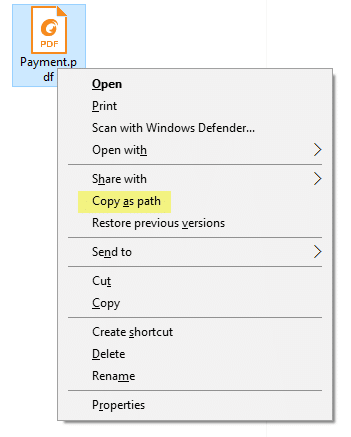
The much useful “Copy as Path” built-in context menu exists in all versions of Windows. It’s an extended command which means you need to hold down the Shift key to access the extended menu item. Press and hold Shift, and right-click on a file or folder. Click “Copy as Path option” in the context menu. The object’s (file or folder) full path is now copied to the Clipboard.

Here is how the standard “Copy as Path” option appears.

copy-as-path-always-show-windows-10
Copy as path right-click menu with Shift pressed.

Always Show “Copy as Path” in the Right-click Menu

If you frequently use Copy as Path, having to access it by pressing the Shift key every time can be annoying like hell. There is a registry tweak to show the menu by default without having to press the Shift key down.

  1. Copy the following lines to Notepad.
    Windows Registry Editor Version 5.00
    
    ;Show Copy as Path always in the right-click menu, without pressing SHIFT
    ;Ramesh Srinivasan, Winhelponline.com
    
    [HKEY_CLASSES_ROOT\Allfilesystemobjects\shell\windows.copyaspath]
    @="Copy &as path"
    "Icon"="imageres.dll,-5302"
    "InvokeCommandOnSelection"=dword:00000001
    "VerbHandler"="{f3d06e7c-1e45-4a26-847e-f9fcdee59be0}"
    "VerbName"="copyaspath"
    
  2. Save the file as copyaspath.reg – see also How to use .REG files
  3. Double-click the registry file to run it.

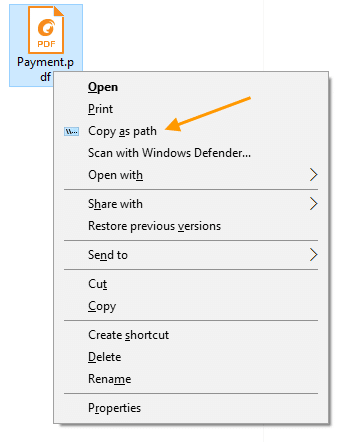
Here is how the new “Copy as path” command appears in the context menu of a file or folder.

copy-as-path-always-show-windows-10
Copy as Path menu option without using Shift.

(The above registry tweak is based on the article How to Add a Ribbon Command to Right-click Menu)

Optionally, you can customize the menu icon by editing the “Icon” path in the REG file or the registry directly.

Vim Stuff

Since the 1970s, Vi and Vim are popular amongst developers and are present on most UNIX-based servers.

These free and open source modal text editors can be a bit hard to use at first, but they are extremely powerful.

Table of Contents  show 

A Quick Intro to Vim

Vi is a modal text editor first released in 1976 for Unix systems. Vim, (Vi Improved) Vi’s successor, was first released in 1991. Despite its very old age, Vim is extremely popular among web developers and system administrators, as it is installed by default on all Unix-based systems (Mac OS and Linux distros).Unlike classic text editors, Vim features different modes used for different operations. Vim has a total of 12 modes, although you will mostly use the following:

  • Insert Mode: This mode is used to insert text by typing, like you would do on any other text editor. To enter insert mode, type i while in command mode.
  • Command Mode: Also named Normal Mode, this mode is used to type Vim commands such as those you’ll find in our Vim Cheat Sheet. To exit insert mode and enter command mode, hit the Esc key of your keyboard.
  • Visual Mode: Similar to command mode, but used to highlight areas of text. Normal commands are run on the highlighted area, which, for instance, can be used to move or edit a selection. Press the v key to start visual mode. To exit visual mode, press the Esc key.

Basics

Let’s start with basic commands that will allow you to write, save and quit files. Remember that these Vim commands need to be typed while in command or visual mode. Exit insert mode by hitting the Esc key, then type the command of your choice.

:e filename Open filename for edition
:w Save file
:q Exit Vim
:q! Quit without saving current file
😡 Write/Save file (if changes has been made) and exit
:sav filename Save current file as filename
. Repeat the last change made in normal mode
5. Repeat 5 times the last change made in normal mode

Moving In The File

Vim features powerful commands that allow you to easily move the cursor position to any desired location within the current file, making it quick and easy to insert text.

k or Up Arrow move cursor up one line
j or Down Arrow move cursor down one line
e move cursor to the end of the word
b move the cursor to the beginning of the word
0 move the cursor to the first non-blank character of the line
G move the cursor to the end of the file
gg move the cursor position to the beginning of the file
L move the cursor to the bottom of the screen
:59 move cursor to line 59. Replace 59 by the desired line number.
% Move cursor to matching parenthesis
[[ Jump to function start
[{ Jump to block start

Cut, Copy & Paste

Vim features powerful functions to cut, copy, and paste. This section of our Vim Cheat Sheet will show you how to easily perform those operations. Please note that y stands for yank in Vim, which in other editors is usually called copy.

y Yank/Copy the selected text to clipboard
p Paste clipboard contents
dd Cut current line
yw Yank/Copy word
yy Yank/Copy current line
y$ Yank/Copy to end of line
D Cut to end of line

Search

Searching a string within a huge file or multiple files can be tricky. Thanks to Vim, using a few commands you can easily find whatever you’re looking for.

/word Search word from top to bottom
?word Search word from bottom to top
* Search the word under cursor
/\cstring Search STRING or string, case insensitive
/jo[ha]n Search john or joan
/\< the Search the, theatre or then
/the\> Search the or breathe
/\< the\> Search the
/\< ¦.\> Search all words consisting of 4 letters
/\/ Search fred but not alfred or frederick
/fred\|joe Search fred or joe
/\<\d\d\d\d\> Search exactly 4 digits
/^\n\{3} Find 3 empty lines
:bufdo /searchstr/ Search in multiple files
bufdo %s/something/somethingelse/g Search something in all the open buffers and replace it with somethingelse

Replace

Similar to Search, Vim features powerful commands to replace any given text. This part of our cheat sheet contains Vim commands for replacing any portion of text with another.

:%s/old/new/g Replace all occurrences of old with new in file
:%s/onward/forward/gi Replace onward with forward, case insensitive
:%s/old/new/gc Replace all occurrences with confirmation
:2,35s/old/new/g Replace all occurrences between lines 2 and 35
:5,$s/old/new/g Replace all occurrences from line 5 to EOF
:%s/^/hello/g Replace the beginning of each line by hello
:%s/$/Harry/g Replace the end of each line by Harry
:%s/onward/forward/gi Replace onward with forward, case insensitive
x Delete character
:%s/ *$//g Delete all white spaces and keep any non-blank character
:g/string/d Delete all lines containing string
:v/string/d Delete all lines not containing string
:s/Bill/Steve/ Replace the first occurrence of Bill with Steve in current line
:s/Bill/Steve/g Replace Bill with Steve in current line
:%s/Bill/Steve/g Replace Bill with Steve in all of the file
:%s/^M//g Delete DOS carriage returns (^M)
:%s/\r/\r/g Transform DOS carriage returns in returns
:%s#<[^>]\+>##g Delete HTML tags but keep text
:%s/^\(.*\)\n\1$/\1/ Delete lines that appear twice
Ctrl+a Increment number under the cursor
Ctrl+x Decrement number under cursor
ggVGg? Change text to Rot13

Case

Vim provides very interesting commands to deal with case. Let’s continue to explore our Vim Cheat Sheet with super useful case-related commands.

Vu Lowercase line
VU Uppercase line
g~~ Invert case
vEU Switch word to uppercase
vE~ Modify word case
ggguG Set all text to lowercase
gggUG Set all text to uppercase
:set ignorecase Ignore case in searches
:set smartcase Ignore case in searches except if an uppercase letter is used
:%s/\<./\u&/g Sets the first letter of each word to uppercase
:%s/\<./\l&/g Sets the first non-blank character of each word to lowercase
:%s/.*/\u& Sets the first character of the line to uppercase
:%s/.*/\l& Sets the first character of the line to lowercase

Read and Write Files

Vim allows easy manipulation of files. Listed below are a few examples of file manipulation with Vim.

:1,10 w outfile Save lines 1 to 10 in outfile
:1,10 w >> outfile Append lines 1 to 10 to outfile
:r infile Insert the content of infile
:23r infile Insert the content of infile under line 23

File Explorer

Vim features a built-in file explorer that allows its users to quickly visualize and open files in the editor.

:e . Open integrated file explorer
:Sex Split window and open integrated file explorer
:Sex! Same as :Sex but splits window vertically
:browse e Graphical file explorer
:ls List buffers
:cd .. Move to parent directory
:args List files
:args *.php Open file list
:grep expression *.php Return a list of .php files contening expression
gf Open file name under cursor

Interacting With Unix

As Vi and Vim were initially built for Unix systems, the text editor can interact with the OS.

:!pwd Execute the pwd Unix command, then return to Vi
!!pwd Execute the pwd unix command and insert output in file
:sh Temporary return to Unix
$exit Return to Vi

Alignment

Using Vim, it’s possible to automatically align lines using a few simple commands. Here are the main important ones:

:%!fmt Align all lines
!}fmt Align all lines at the current position
5!!fmt Align the next 5 lines

Tabs and Windows

Vim can use various tabs and windows, which is very useful for working with many files at once.

:tabnew Create/Open a new tab
gt Show next tab
:tabfirst Show first tab
:tablast Show last tab
:tabm n(position) Rearrange tabs
:tabdo %s/foo/bar/g Execute a command in all tabs
:tab ball Puts all open files in tabs (Each in a new tab)
:new abc.txt Edit abc.txt in new window

Window Spliting

As a web developer, I always like to split my Vim editor in two parts, one for my HTML and one for my CSS stylesheet. This part of our Vim Cheat Sheet describes how to split the main editor window.

:e filename Edit filename in current window
:split filename Split the window and open filename
ctrl-w up arrow Put cursor in top window
ctrl-w ctrl-w Put cursor in next window
ctrl-w_ Maximize current window vertically
ctrl-w| Maximize current window horizontally
ctrl-w= Gives the same size to all windows
10 ctrl-w+ Add 10 lines to current window
:vsplit file Split window vertically
:sview file Same as :split in Read Only Mode
:hide Close current window
:­nly Close all windows, except current
:b 2 Open #2 in this window

Auto Completion

Like much more modern editors, Vim can auto-complete your code and use dictionaries.

Ctrl+N Ctrl+P (in insert mode) Complete word
Ctrl+x Ctrl+l Complete line
:set dictionary=dict Define dict as a dictionary
Ctrl+x Ctrl+k Complete with dictionary

Markers

Vim allows its users to set marks at a position of their choice, so they can easily jump back to that predefined position. A must when working with large files.

m {a-z} Marks current position as {a-z}
‘ {a-z} Move to position {a-z}
Move to previous position

Abbreviations

Another handy Vim function is the possibility to define abbreviations.

:ab mail mail@provider.org Define mail as abbreviation of mail@provider.org

Text Indent

Indentation is the key to readable and easy-to-maintain code. Vim possesses a few commands that will come in handy for indenting any file.

:set autoindent Turn on auto-indent
:set smartindent Turn on intelligent auto-indent
:set shiftwidth=4 Define 4 spaces as indent size
ctrl-t, ctrl-d Indent/un-indent in insert mode
>> Indent
<< Un-indent
=% Indent the code between parenthesis
1GVG= Indent the whole file

Syntax Highlighting

Syntax highlighting is often very useful for preventing coding mistakes and typos. Vim can work with many different syntax highlighting modes, depending on which programming language you are coding with.

:syntax on Turn on syntax highlighting
:syntax off Turn off syntax highlighting
:set syntax=perl Force syntax highlighting

130+ Vim Commands

Essential Vim Commands

Since the 1970’s, Vi and its successor Vim have been included by default on many operating systems, including almost all GNU/Linux distributions.

Vim is free and open-source and is one of the most popular code editors. It can be downloaded on Vim official site.

Table of Contents  show 

Vim is a modal text editor, which means that it has a mode for writing text, a mode for running commands, etc.

Vim has a total of 12 different editing modes.

The three main modes are:

  • Command mode (also sometimes referred to as Normal mode) is where you can run commands. This is the default mode in which Vim starts up.
  • Insert mode is the mode where you insert/write your text.
  • Visual mode is where you visually select a bunch of text so that you can run a command/operation only on that part of the text.

Basic Vim Commands

Let’s start with an easy set of Vim commands to open, save, and exit Vim.

:e filename Open filename for edition
:w Save file
:q Exit Vim
:q! Quit without saving
😡 Write file (if changes has been made) and exit
:sav filename Saves file as filename
. Repeats the last change made in normal mode

Moving in the File

While in command mode, the following set of commands will allow you to easily move the cursor in the file, jump to a particular line number, or set the cursor position at the beginning of the file.

k or Up Arrow move the cursor position up one line
j or Down Arrow move the cursor down one line
e move the cursor to the end of the word
b move the cursor to the beginning of the word
0 move the cursor to the beginning of the line
G move the cursor to the end of the file
gg move the cursor to the beginning of the file
L move the cursor to the bottom of the screen
:59 move cursor to line number 59. Replace 59 by the desired line number.
% Move cursor to matching parenthesis
[[ Jump to function start
[{ Jump to block start

Cut, Copy & Paste

Here are some basic Vim commands to cut, copy and paste portions of text. All the commands below has to be ran in command mode.

y Copy the selected text to clipboard
p Paste clipboard contents
dd Cut current line
yy Copy current line
y$ Copy to end of line
D Cut to end of line

Search

In command mode, you can easily search for any string within a file. This is extremely useful for developers and sysadmins alike.

/word Search word from top to bottom
?word Search word from bottom to top
* Search the word under cursor
/\cstring Search STRING or string, case insensitive
/jo[ha]n Search john or joan
/\< the Search the, theatre or then
/the\> Search the or breathe
/fred\|joe Search fred or joe
/\<\d\d\d\d\> Search exactly 4 digits
/^\n\{3} Find 3 empty lines
:bufdo /searchstr/ Search in all open files
bufdo %s/something/somethingelse/g Search something in all the open buffers and replace it with somethingelse

Replace

Vim command line tool is extremely useful to replace many occurrences of a string by another within a file. Using more advanced commands, there are a lot of search and replace options available.

:%s/old/new/g Replace all occurrences of old by new in file
:%s/onward/forward/gi Replace onward by forward, case insensitive
:%s/old/new/gc Replace all occurrences with confirmation
:%s/^/hello/g Replace the beginning of each line by hello
:%s/$/Harry/g Replace the end of each line by Harry
:%s/onward/forward/gi Replace onward by forward, case insensitive
:%s/ *$//g Delete all white spaces
:g/string/d Delete all lines containing string
:v/string/d Delete all lines containing which didn’t contain string
:s/Bill/Steve/ Replace the first occurrence of Bill by Steve in current line
:s/Bill/Steve/g Replace Bill by Steve in current line
:%s/Bill/Steve/g Replace Bill by Steve in all the file
:%s/^M//g Delete DOS carriage returns (^M)
:%s/\r/\r/g Transform DOS carriage returns in returns
:%s#<[^>]\+>##g Delete HTML tags but keeps text
:%s/^\(.*\)\n\1$/\1/ Delete lines which appears twice
Ctrl+a Increment number under the cursor
Ctrl+x Decrement number under cursor
ggVGg? Change text to Rot13

Case

Vim has some powerful commands to modify the case of text. All the commands below have to be run in command mode.

Vu Lowercase line
VU Uppercase line
g~~ Invert case
vEU Switch word to uppercase
vE~ Modify word case
ggguG Set all text to lowercase
gggUG Set all text to uppercase
:set ignorecase Ignore case in searches
:set smartcase Ignore case in searches excepted if an uppercase letter is used
:%s/\<./\u&/g Sets first letter of each word to uppercase
:%s/\<./\l&/g Sets first letter of each word to lowercase
:%s/.*/\u& Sets first letter of each line to uppercase
:%s/.*/\l& Sets first letter of each line to lowercase

Read and Write Files

Vim is clearly one of the most powerful text editors available. This section shows how you can manipulate files, insert the content of a file into another, and export portions of a file into a new file.

:1,10 w outfile Saves lines 1 to 10 in outfile
:1,10 w >> outfile Appends lines 1 to 10 to outfile
:r infile Insert the content of infile
:23r infile Insert the content of infile under line 23

File Explorer

Vim features a built in file explorer, which allows you to explorer the content of your server without exiting the text editor.

:e . Open integrated file explorer
:Sex Split window and open integrated file explorer
:Sex! Same as :Sex but split window vertically
:browse e Graphical file explorer
:ls List buffers
:cd .. Move to parent directory
:args List files
:args *.php Open file list
:grep expression *.php Returns a list of .php files containing expression
gf Open file name under cursor

Interact With Unix

Vim is installed by default on most Unix based operating systems, including Mac OS and most GNU/Linux distros. It therefore feature various commands that allows you to interact with the OS.

:!pwd Execute the pwd unix command, then returns to Vi
!!pwd Execute the pwd unix command and insert output in file
:sh Temporary returns to Unix
$exit Retourns to Vi

Alignment

In command mode, you can quickly and easily align a file’s lines for better clarity.

:%!fmt Align all lines
!}fmt Align all lines at the current position
5!!fmt Align the next 5 lines

Tabs and Windows

One of my favorite Vim options is the ability to use tabs to edit various files at the same time. The following Vim commands will let you open, close, and organize your tabs for better productivity.

:tabnew Creates a new tab
gt Show next tab
:tabfirst Show first tab
:tablast Show last tab
:tabm n(position) Rearrange tabs
:tabdo %s/foo/bar/g Execute a command in all tabs
:tab ball Puts all open files in tabs
:new abc.txt Edit abc.txt in new window

Window Spliting

Vim allows you to split the screen horizontally or vertically, so you can edit many files at once using the insert mode.

:e filename Edit filename in current window
:split filename Split the window and open filename
ctrl-w up arrow Puts cursor in top window
ctrl-w ctrl-w Puts cursor in next window
ctrl-w_ Maximize current window vertically
ctrl-w| Maximize current window horizontally
ctrl-w= Gives the same size to all windows
10 ctrl-w+ Add 10 lines to current window
:vsplit file Split window vertically
:sview file Same as :split in readonly mode
:hide Close current window
:­nly Close all windows, excepted current
:b 2 Open #2 in this window

Auto-Completion

Vim can use external dictionaries to provide auto-completion. This can be a real time saver, so pay attention to the commands below if you want to speed up your workflow.

Ctrl+n Ctrl+p (To be used in insert mode) Complete word
Ctrl+x Ctrl+l Complete line
:set dictionary=dict Define dict as a dictionary
Ctrl+x Ctrl+k Complete with dictionary

Marks

When editing large files, it can be tricky to move in the file and remember important sections. Happily, Vim allows its users to create marks that can easily be accessed later. No need to remember a dozen of line numbers anymore!

m {a-z} Marks current position as {a-z}
‘ {a-z} Move to position {a-z}
Move to previous position

Abbreviations

This little known trick lets you define abbreviations that can be reused later and as many times as needed.

:ab mail mail@provider.org Define mail as abbreviation of mail@provider.org

Text Indentation

Text indentation is vital when it comes to code readability. Luckily, Vim has a set of commands for the text editor to indent your lines in a clear and readable manner.

:set autoindent Turn on auto-indent
:set smartindent Turn on intelligent auto-indent
:set shiftwidth=4 Defines 4 spaces as indent size
ctrl-t, ctrl-d Indent/un-indent in insert mode
>> Indent
<< Un-indent
=% Indent the code between parenthesis
1GVG= Indent the whole file

Frequently Asked Questions

Vim basic commands

How do I Type Commands in Vim?

To type commands, you have to first activate Vim’s command mode. To do so, press the Esc key of your keyboard. You can then type any command of your choice.

How do I Start Typing Text in Vim?

Vim must be in insert mode for you to type text. Simply press the i key when in command mode to enter the insert mode.