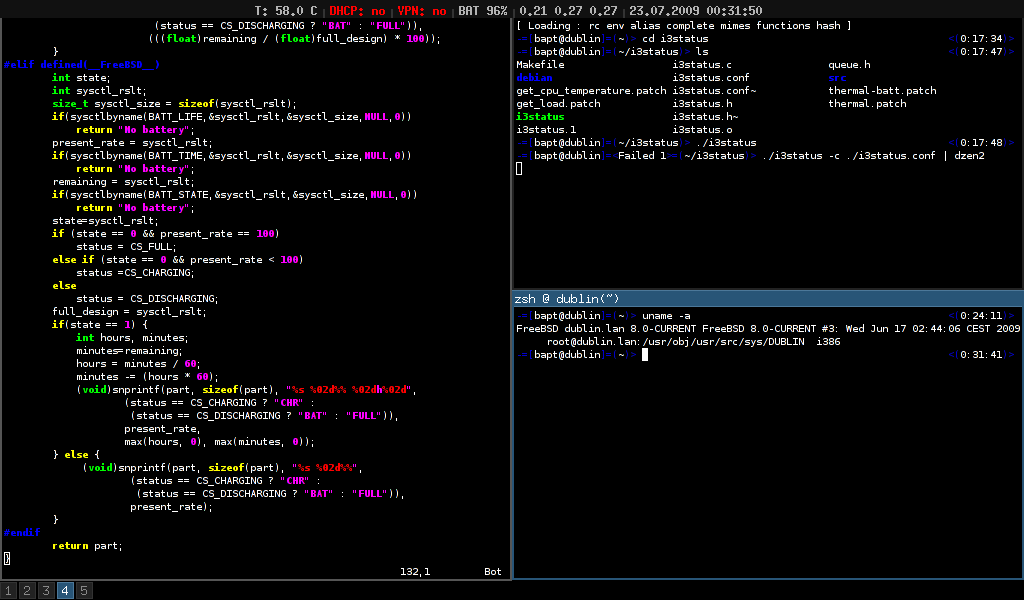
Vim is a modal text editor, which means that it has a mode for writing text, a mode for running commands, etc.
Vim has a total of 12 different editing modes.
The three main modes are:
- Command mode (also sometimes referred to as Normal mode) is where you can run commands. This is the default mode in which Vim starts up.
- Insert mode is the mode where you insert/write your text.
- Visual mode is where you visually select a bunch of text so that you can run a command/operation only on that part of the text.
Basic Vim Commands
Let’s start with an easy set of Vim commands to open, save, and exit Vim.
| :e filename |
Open filename for edition |
| :w |
Save file |
| :q |
Exit Vim |
| :q! |
Quit without saving |
| 😡 |
Write file (if changes has been made) and exit |
| :sav filename |
Saves file as filename |
| . |
Repeats the last change made in normal mode |
Moving in the File
While in command mode, the following set of commands will allow you to easily move the cursor in the file, jump to a particular line number, or set the cursor position at the beginning of the file.
| k or Up Arrow |
move the cursor position up one line |
| j or Down Arrow |
move the cursor down one line |
| e |
move the cursor to the end of the word |
| b |
move the cursor to the beginning of the word |
| 0 |
move the cursor to the beginning of the line |
| G |
move the cursor to the end of the file |
| gg |
move the cursor to the beginning of the file |
| L |
move the cursor to the bottom of the screen |
| :59 |
move cursor to line number 59. Replace 59 by the desired line number. |
| % |
Move cursor to matching parenthesis |
| [[ |
Jump to function start |
| [{ |
Jump to block start |
Cut, Copy & Paste
Here are some basic Vim commands to cut, copy and paste portions of text. All the commands below has to be ran in command mode.
| y |
Copy the selected text to clipboard |
| p |
Paste clipboard contents |
| dd |
Cut current line |
| yy |
Copy current line |
| y$ |
Copy to end of line |
| D |
Cut to end of line |
Search
In command mode, you can easily search for any string within a file. This is extremely useful for developers and sysadmins alike.
| /word |
Search word from top to bottom |
| ?word |
Search word from bottom to top |
| * |
Search the word under cursor |
| /\cstring |
Search STRING or string, case insensitive |
| /jo[ha]n |
Search john or joan |
| /\< the |
Search the, theatre or then |
| /the\> |
Search the or breathe |
| /fred\|joe |
Search fred or joe |
| /\<\d\d\d\d\> |
Search exactly 4 digits |
| /^\n\{3} |
Find 3 empty lines |
| :bufdo /searchstr/ |
Search in all open files |
| bufdo %s/something/somethingelse/g |
Search something in all the open buffers and replace it with somethingelse |
Replace
Vim command line tool is extremely useful to replace many occurrences of a string by another within a file. Using more advanced commands, there are a lot of search and replace options available.
| :%s/old/new/g |
Replace all occurrences of old by new in file |
| :%s/onward/forward/gi |
Replace onward by forward, case insensitive |
| :%s/old/new/gc |
Replace all occurrences with confirmation |
| :%s/^/hello/g |
Replace the beginning of each line by hello |
| :%s/$/Harry/g |
Replace the end of each line by Harry |
| :%s/onward/forward/gi |
Replace onward by forward, case insensitive |
| :%s/ *$//g |
Delete all white spaces |
| :g/string/d |
Delete all lines containing string |
| :v/string/d |
Delete all lines containing which didn’t contain string |
| :s/Bill/Steve/ |
Replace the first occurrence of Bill by Steve in current line |
| :s/Bill/Steve/g |
Replace Bill by Steve in current line |
| :%s/Bill/Steve/g |
Replace Bill by Steve in all the file |
| :%s/^M//g |
Delete DOS carriage returns (^M) |
| :%s/\r/\r/g |
Transform DOS carriage returns in returns |
| :%s#<[^>]\+>##g |
Delete HTML tags but keeps text |
| :%s/^\(.*\)\n\1$/\1/ |
Delete lines which appears twice |
| Ctrl+a |
Increment number under the cursor |
| Ctrl+x |
Decrement number under cursor |
| ggVGg? |
Change text to Rot13 |
Case
Vim has some powerful commands to modify the case of text. All the commands below have to be run in command mode.
| Vu |
Lowercase line |
| VU |
Uppercase line |
| g~~ |
Invert case |
| vEU |
Switch word to uppercase |
| vE~ |
Modify word case |
| ggguG |
Set all text to lowercase |
| gggUG |
Set all text to uppercase |
| :set ignorecase |
Ignore case in searches |
| :set smartcase |
Ignore case in searches excepted if an uppercase letter is used |
| :%s/\<./\u&/g |
Sets first letter of each word to uppercase |
| :%s/\<./\l&/g |
Sets first letter of each word to lowercase |
| :%s/.*/\u& |
Sets first letter of each line to uppercase |
| :%s/.*/\l& |
Sets first letter of each line to lowercase |
Read and Write Files
Vim is clearly one of the most powerful text editors available. This section shows how you can manipulate files, insert the content of a file into another, and export portions of a file into a new file.
| :1,10 w outfile |
Saves lines 1 to 10 in outfile |
| :1,10 w >> outfile |
Appends lines 1 to 10 to outfile |
| :r infile |
Insert the content of infile |
| :23r infile |
Insert the content of infile under line 23 |
File Explorer
Vim features a built in file explorer, which allows you to explorer the content of your server without exiting the text editor.
| :e . |
Open integrated file explorer |
| :Sex |
Split window and open integrated file explorer |
| :Sex! |
Same as :Sex but split window vertically |
| :browse e |
Graphical file explorer |
| :ls |
List buffers |
| :cd .. |
Move to parent directory |
| :args |
List files |
| :args *.php |
Open file list |
| :grep expression *.php |
Returns a list of .php files containing expression |
| gf |
Open file name under cursor |
Interact With Unix
Vim is installed by default on most Unix based operating systems, including Mac OS and most GNU/Linux distros. It therefore feature various commands that allows you to interact with the OS.
| :!pwd |
Execute the pwd unix command, then returns to Vi |
| !!pwd |
Execute the pwd unix command and insert output in file |
| :sh |
Temporary returns to Unix |
| $exit |
Retourns to Vi |
Alignment
In command mode, you can quickly and easily align a file’s lines for better clarity.
| :%!fmt |
Align all lines |
| !}fmt |
Align all lines at the current position |
| 5!!fmt |
Align the next 5 lines |
Tabs and Windows
One of my favorite Vim options is the ability to use tabs to edit various files at the same time. The following Vim commands will let you open, close, and organize your tabs for better productivity.
| :tabnew |
Creates a new tab |
| gt |
Show next tab |
| :tabfirst |
Show first tab |
| :tablast |
Show last tab |
| :tabm n(position) |
Rearrange tabs |
| :tabdo %s/foo/bar/g |
Execute a command in all tabs |
| :tab ball |
Puts all open files in tabs |
| :new abc.txt |
Edit abc.txt in new window |
Window Spliting
Vim allows you to split the screen horizontally or vertically, so you can edit many files at once using the insert mode.
| :e filename |
Edit filename in current window |
| :split filename |
Split the window and open filename |
| ctrl-w up arrow |
Puts cursor in top window |
| ctrl-w ctrl-w |
Puts cursor in next window |
| ctrl-w_ |
Maximize current window vertically |
| ctrl-w| |
Maximize current window horizontally |
| ctrl-w= |
Gives the same size to all windows |
| 10 ctrl-w+ |
Add 10 lines to current window |
| :vsplit file |
Split window vertically |
| :sview file |
Same as :split in readonly mode |
| :hide |
Close current window |
| :nly |
Close all windows, excepted current |
| :b 2 |
Open #2 in this window |
Auto-Completion
Vim can use external dictionaries to provide auto-completion. This can be a real time saver, so pay attention to the commands below if you want to speed up your workflow.
| Ctrl+n Ctrl+p (To be used in insert mode) |
Complete word |
| Ctrl+x Ctrl+l |
Complete line |
| :set dictionary=dict |
Define dict as a dictionary |
| Ctrl+x Ctrl+k |
Complete with dictionary |
Marks
When editing large files, it can be tricky to move in the file and remember important sections. Happily, Vim allows its users to create marks that can easily be accessed later. No need to remember a dozen of line numbers anymore!
| m {a-z} |
Marks current position as {a-z} |
| ‘ {a-z} |
Move to position {a-z} |
| ” |
Move to previous position |
Abbreviations
This little known trick lets you define abbreviations that can be reused later and as many times as needed.
| :ab mail mail@provider.org |
Define mail as abbreviation of mail@provider.org |
Text Indentation
Text indentation is vital when it comes to code readability. Luckily, Vim has a set of commands for the text editor to indent your lines in a clear and readable manner.
| :set autoindent |
Turn on auto-indent |
| :set smartindent |
Turn on intelligent auto-indent |
| :set shiftwidth=4 |
Defines 4 spaces as indent size |
| ctrl-t, ctrl-d |
Indent/un-indent in insert mode |
| >> |
Indent |
| << |
Un-indent |
| =% |
Indent the code between parenthesis |
| 1GVG= |
Indent the whole file |